
Across Europe, debates about young people, social media and online safety have become more visible in recent months. Proposals in countries such as France and Spain to restrict internet access for under-15s and under-16s are rooted in real concerns about harm, misinformation and the pressures that online spaces can place on young people. These concerns are widely shared by parents, educators and policymakers who are trying to respond responsibly to a rapidly changing digital environment.
These discussions also invite reflection on another important issue. Alongside questions of access and protection, how do we help young people understand the online world they are growing up in and will continue to encounter as they move into adulthood?
This is what the ARENAS project addresses in Work Package 5, and is addressing by building an online learning platform.
From protection to understanding
ARENAS examines how extremist narratives take shape, circulate and gain influence across Europe, particularly in relation to gender, science and the nation. Much of this research focuses on language, discourse, law and politics, helping to clarify how narratives operate at societal and institutional levels.
Work Package 5 approaches this challenge from a different angle. It asks how people experience narratives in everyday settings and how they learn to make sense of stories that are confusing, emotionally charged or unfair. Rather than assuming that harmful narratives are only created by clearly identifiable bad actors, WP5 looks at the ordinary social conditions in which narratives become persuasive. These include humour, silence, group dynamics, uncertainty and the human need to belong.
This shift matters because it recognises that young people are not simply passive recipients of online content. They are active interpreters of stories, both online and offline.
A remediative approach rooted in everyday experience
In Work Package 5, remediation does not mean correcting behaviour or telling young people what to think. Instead, it focuses on building awareness and reflection. The aim is to help learners notice how stories work, how language shapes understanding and how small choices can influence the direction a situation takes.
Over the past year, the Work Package 5 team from CNRS, University of Genoa and Momentum, together with the wider community of project partners have worked with secondary school students in Spain, Italy and Latvia to pilot a series of scenario-based learning activities with students aged 14 to 16. These scenarios follow a small group of fictional classmates over several weeks as misunderstandings, jokes, rumours and online interactions gradually unfold.
Students are asked to make choices at key moments, reflect on how those choices feel and consider how different perspectives might exist at the same time. There are no right or wrong answers and no expectation that situations will be neatly resolved. Change, when it happens, is partial and sometimes uncomfortable, reflecting the realities of school life.
This approach allows students to engage with difficult situations without being pushed towards judgment or blame.
Language, silence and what goes unsaid
One of the insights emerging from Work Package 5 is the importance of language choices, including what is not said as much as what is said. Stories often gain power through omission, simplification or repetition rather than through explicit statements.
Through the scenarios, students begin to notice who speaks, who stays silent and whose version of events becomes accepted as the dominant story. They explore how humour can mask harm, how claims of neutrality or objectivity can still carry bias and how stories can harden when alternative voices are no longer heard.
By working through these moments, learners practise recognising when a situation feels unfair and how language might be used to open space for more balanced and respectful outcomes.
Safer internet use as a learned skill
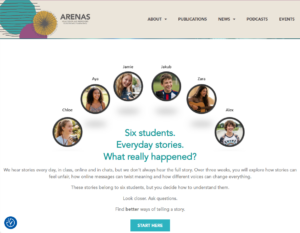
Safer Internet Day encourages reflection on how young people can be supported to navigate online environments with confidence and care. Work Package 5 complements discussions about regulation and protection by focusing on skills that develop over time, such as critical listening, empathy and the ability to question narratives without escalating conflict.
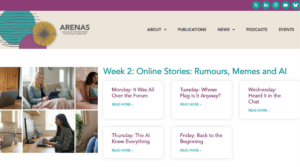 As part of its work, ARENAS is developing an online learning platform within Work Package 5, which will launch on the ARENAS website later this year. The platform is designed primarily for young people aged 14–16, with dedicated resources for educators. Through a series of interconnected scenarios, reflection tools and guided activities, it supports learners in exploring how online and offline stories form, how language and emotion shape understanding and how more inclusive and fair narratives can be developed over time. Rather than offering simple answers, the platform encourages critical awareness, empathy and thoughtful engagement with the digital world young people already inhabit.
The platform, currently under development, will bring these ideas together in an accessible way. It will include a self-guided pathway for students built around interconnected scenarios, resources for educators, including lesson plans and open educational materials and a section that allows users to explore related findings from other parts of the ARENAS project. Together, these elements aim to support long-term understanding rather than short-term compliance.
Looking ahead
Debates about online safety are complex and evolving. While protective measures play an important role, they do not on their own help young people develop the confidence to interpret and respond to the stories they encounter every day.
Work Package 5 contributes to this wider conversation by focusing on how understanding can be built through reflection, dialogue and careful attention to language. By helping young people recognise how narratives work, the project supports their capacity to engage with the digital world in thoughtful and informed ways.
That is the mission at the heart of ARENAS Work Package 5. You can learn more here. Follow our social media channels and be the first to learn when the online learning platform is launched.